Separate a visible scene from a reported claim
A photograph of a crowd can carry several stories at once. The caption may describe an event, the headline may make a claim about public feeling, and a person sharing the image may add a conclusion of their own. Read those layers separately. An image can show a public setting without establishing the reason every person is there.
On The Public Chapter, the supplied images are editorial illustrations. We have not verified a date, organiser or named gathering for them. We therefore do not attach an attendance figure, a collective demand or a policy outcome to the scene. Canadian flags and a Toronto landmark provide visual context; they do not identify anyone’s political beliefs.
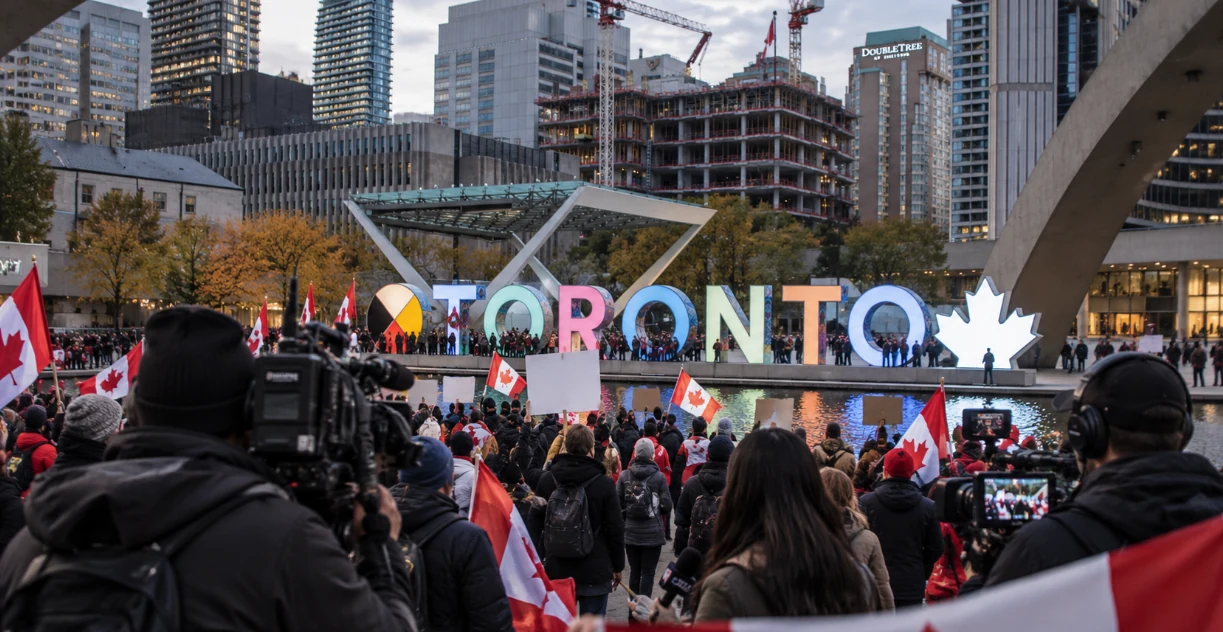
The first useful question is specific: “What, exactly, is being claimed?” A claim that a meeting was announced, a claim that it took place and a claim that it changed a decision require different evidence. A strong visual does not close those gaps.
Find the original notice or record
For an upcoming gathering, begin with the notice from the organiser. Look for a clear purpose, a current date, the meeting format and contact information that belongs to that organiser. A cropped poster or forwarded screenshot may have lost a correction, cancellation or registration instruction.
If the story concerns Nathan Phillips Square, the City’s event schedule is a useful reference that points readers to event organisers. For a wider search, the City’s event directory links to City and community listings. Neither should be read as proof of what every person in a separate image was doing. The schedule’s absence of an item is not, on its own, a finding about that item’s legitimacy.
Different claims call for different records. An organiser can describe what it intended to hold. A report can describe what the reporter observed. A City project page can explain a public engagement process. Keep the source close to the statement it actually supports.
Keep the dates in separate places
A post’s publication date is not necessarily the date of the image. A current repost can revive an older notice, and an article update can concern details other than a new event. Look for a date attached to the event itself, then check whether the original source has published a change.
Our source review date tells you when the linked material was checked. It is not an event date and does not mean a gathering happened on that day. The articles are explanatory reading, with links to current information where listings and instructions can change.
When a necessary date is missing, describe that uncertainty. “The notice does not give an event date” is more useful than attaching the date of the social post. The same applies to place names: a city name is not a confirmed meeting point.
A conversation is not yet a decision
Stories about civic life sometimes move quickly from “residents discussed” to “the City decided”. Check the stage of the process. Have Your Say Toronto distinguishes public engagement projects and stages, including ongoing and concluded opportunities. The relevant project page is the place to read the scope and updates.
Where an article refers to an agenda item, use the links in the City’s Council and committee participation guidance to find the item and its documents. A person’s submission is an attributed view, not automatically the position or final decision of the body receiving it. A request to speak and an opportunity to watch a meeting also have different purposes.
Separate three sentences in your notes: what somebody requested, what information the record provides and what outcome is documented. If you cannot complete the last sentence, keep it open rather than treating an intention as a result.
Go to the original sources
Source review: 11 October 2026. Follow the original pages for current listings, participation instructions and project updates. A source link does not establish an affiliation.